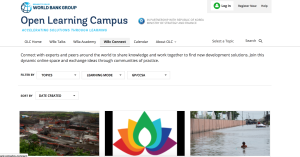
Reposting here from Panoply Digital. Revisiting the world of education ahead of some workshops we are doing in Nigeria and Cambodia where we discuss using open learning as a professional development strategy, (along with some modules on secure communication, online research, and developing an online presence), I wanted to highlight an organization that has done some good work in this area. The World Bank recently launched the Open Learning Campus, a clearinghouse of sorts for all their open learning materials, courses, and talks. While many organizations are doing this type of thing, a welcome trend, I particularly find the World Bank’s approach to be clever in that they are grounding the structure itself on theory. While some implicitly do the same (and many not at all), it is refreshing to see here. The theory itself is Community of Practice theory (Lave & Wenger, 1991) which basically states that much of how we learn is based on our relative position in or near a community of individuals dedicated to a particular task. Amateur photographers, development workers, teachers, doctors, community members all, all have specific practices they perform with specific materials and their identity evolves as a result. The Open Learning Campus itself has a clear level-headed focus on practitioners, those working in the fields that the World Bank serves: development finance, public private partnerships, gender, energy, and more. So the match between theory and structure is sound here. The structure is broken down into So these three sections work ideally in conjunction providing greater levels of engagement as needed, orbits of activity with the community of practice at the center. Some of the communities of practice themselves are directly geared towards the work that we do here at Panoply Digital as well, like: I will keep scouting for more open learning platforms that specifically serve the development communities, but if any are thinking of kicking one off, I would think this would be a good model to start with. It structures activity around community and identity, which is exactly what a lot of ICT4D is or should be attempting to do. We need to be more concerned with maintaining and augmenting communities that already exist, rather than assault them with the empty marketing rhetoric of distuption. Fix supply chains, fix governance, encourage participation, but maintain the core communities on which societies revolve.